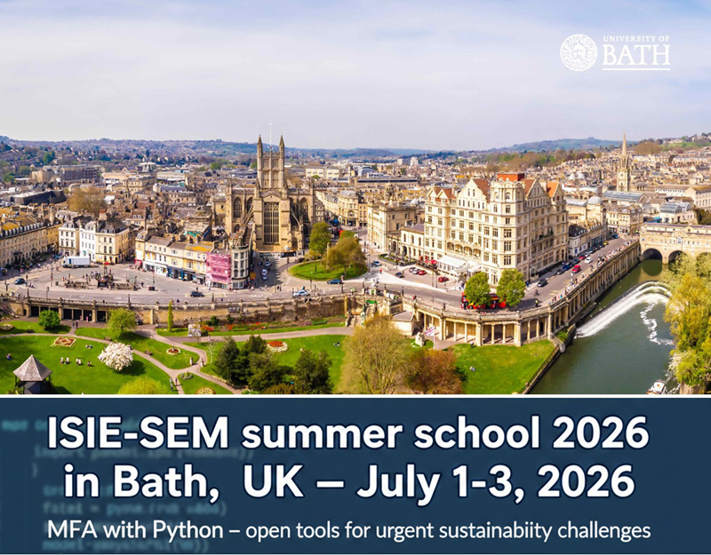
Under the theme “MFA with Python – Open Tools for Urgent Sustainability Challenges,” more than 40 participants, most of them doctoral researchers, gathered at the University of Bath, UK, from July 1-3, 2026, for three days of intensive training on recently developed Python tools for modeling material cycles and stock-flow relationships.
The Bath MFA Summer School was an official side event of the ISIE-SEM Conference in Cambridge and was organized by Rick Lupton, who also served as one of the conference chairs.
The summer school offered three days of world-class training in building, solving, and analyzing dynamic material flow analysis (dMFA) models using a range of Python libraries. The program began with a shared introduction covering the fundamentals of dMFA in Python, uncertainty quantification and Monte Carlo simulation, and best practices for managing Python projects and packages with UV.
During the second half of the summer school, participants split into three thematic tracks, each led by one of the instructors:
- Rick Lupton, University of Bath, UK: Applying uncertainty analysis to dynamic MFA models in Python, together with sensitivity analysis to identify the sources of uncertainty that contribute most to variations in model results.
- Zhi Cao, Nankai University, China: Linking dynamic MFA with the Python-based TEMOA energy system model. This hands-on session demonstrated how material stocks, flows, and associated emissions can be integrated with energy system modeling to shape scenario-based energy pathways and technology choices.
- Stefan Pauliuk, University of Freiburg, Germany: Vehicle fleet modeling of the stock–flow–service nexus using the new flodym package, covering transport demand, greenhouse gas emissions, material footprints, and both inflow-driven and stock-driven fleet models.
All teaching materials developed for the summer school are freely available on GitHub: https://github.com/jerrysong0128/ISIE-SEM_Summer_School_2026
Participants described the three-day program as highly valuable and rewarding, and we hope these emerging Python-based MFA tools will continue to support and strengthen research across the industrial ecology community.
Finally, we sincerely thank our host, Rick Lupton, and the University of Bath for making this successful summer school possible!